.webp)
.png)
By: Caroline Ward
The end of the year is the most important financial checkpoint for a med spa. It is the best point where performance can be measured accurately and decisions for the coming year can be made with real data—not assumptions. Before moving into planning mode, financial records must be complete and reliable. This means closing the day, month, and year in your EMR system and confirming that service revenue, retail sales, memberships, gift cards, payroll, and inventory align with accounting reports.
Once financials are finalized, comparing end-of-year results to the prior year provides a great layer of insight. Start at revenue, then move down to cost of goods, payroll, operating expenses, and net profit, which should all be reviewed as a percentage of revenue, not just a total dollar amount.
Remember: Higher revenue does not always mean stronger performance if margins declined or expenses increased faster than sales.
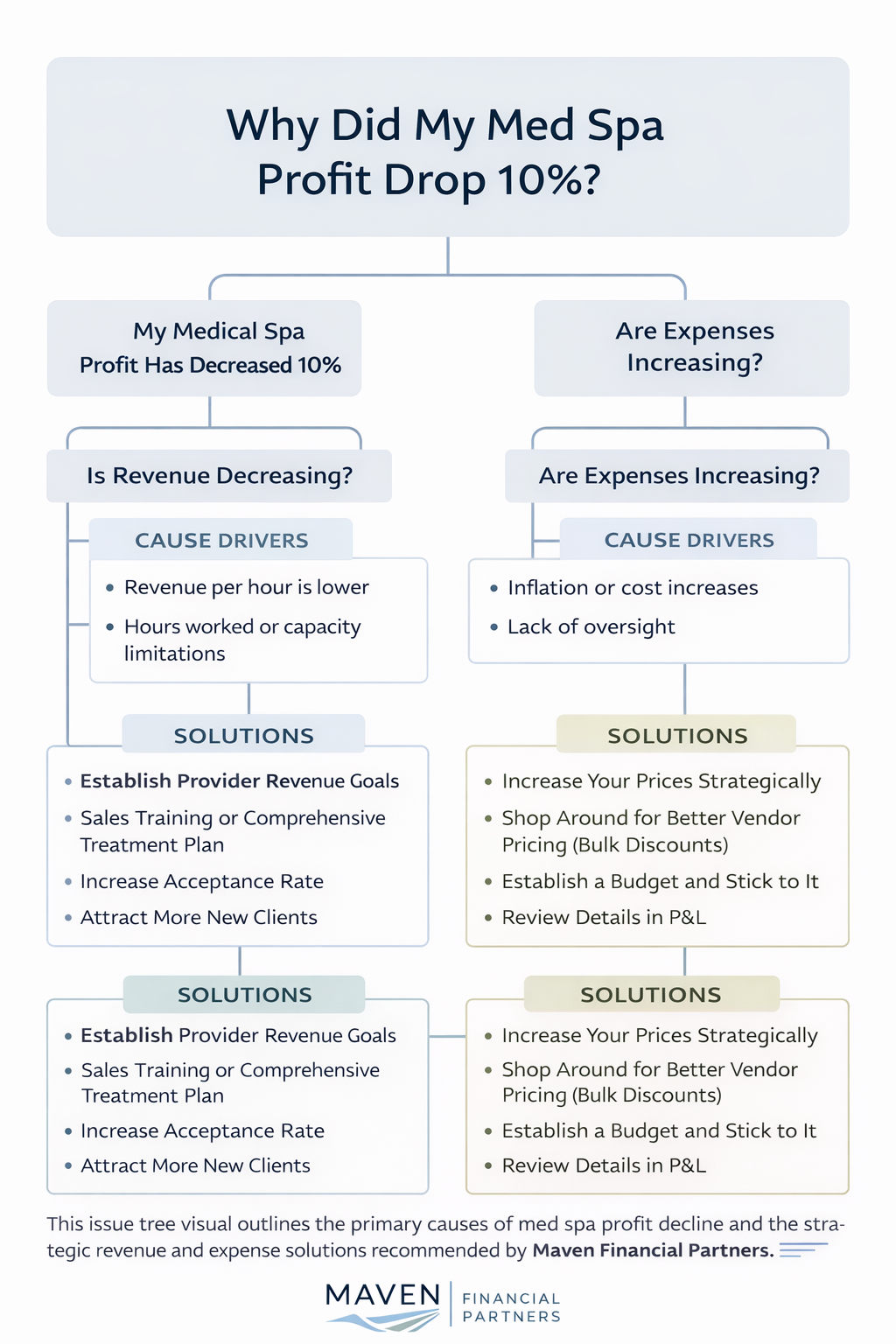
Understanding where growth occurred and where costs changed helps identify what processes should be repeated and what might require adjustment. The “issue tree” shown in the report helps med spa owners determine whether profit loss is driven by reduced revenue, increased expenses, inflation, capacity issues, or lack of oversight.
Next, we should perform a Category Trend Analysis, which involves reviewing revenue by month to highlight seasonal patterns. Breaking revenue down by service category and device type shows which offerings produced consistent returns and which underperformed relative to their cost. High-investment services and equipment should be evaluated based on utilization rates, consumable cost, labor cost, and overall profitability—not just popularity.
Key Performance Indicators (KPIs) such as
provide critical insight into how efficiently your team and schedule are being used.
Marketing ROI should also be evaluated with clear data. Tracking booked appointments and realized revenue helps eliminate ineffective campaigns while doubling down on profitable channels.
Staffing and compensation must be analyzed with the same financial discipline. Payroll should always be measured as a percentage of revenue and evaluated against provider productivity. Year-end is the ideal time to review bonuses, raises, commissions, and job role adjustments based on measurable results—not emotion or seasonal pressure.
For helpful guidance, the Small Business Administration offers best practices on managing labor and operational expenses.
A year-end cash flow review is equally essential. Spa owners should evaluate how cash moved throughout the year—including equipment purchases, lease payments, taxes, bonuses, and owner distributions. Prepaid liabilities such as memberships and gift cards must be included in planning for Q1, because they represent future service obligations.
Practices dealing with inventory challenges should consider reputable inventory partners such as MedVelle, which help streamline ordering, usage tracking, and cost controls.
Planning for the next year should be supported by a 12-month rolling budget, updated periodically as performance shifts. Pricing, inventory levels, and staffing must all align with financial projections to protect margins as supply costs and demand change.
Don’t leave your financial clarity to chance. A disciplined year-end financial review gives you the insight needed to maximize profit margins, streamline operations, strengthen cash flow, and plan for sustainable growth. To get support with financial clarity and year-end planning, visit Maven Financial Partners.
Discover where your business stands in the market with Maven Financial Partners' free benchmark audit. Our expert team will analyze your financial performance, providing you with valuable insights and strategies to outperform your competitors. Take advantage of this opportunity to identify strengths, uncover areas for improvement, and gain a competitive edge. Don't miss out on this chance to enhance your business success with our professional guidance.
.webp)



.png)